
Architecture and Environmental Design Final Reviews Schedule
Studios will hold their final reviews at the Tyler School of Art and Architecture on Monday, April 27, Tuesday, April 28, and Wednesday, April 29.
Join us for three days of final studio reviews with our Undergraduate, Graduate and Architecture Thesis and Landscape Architecture Capstone students.
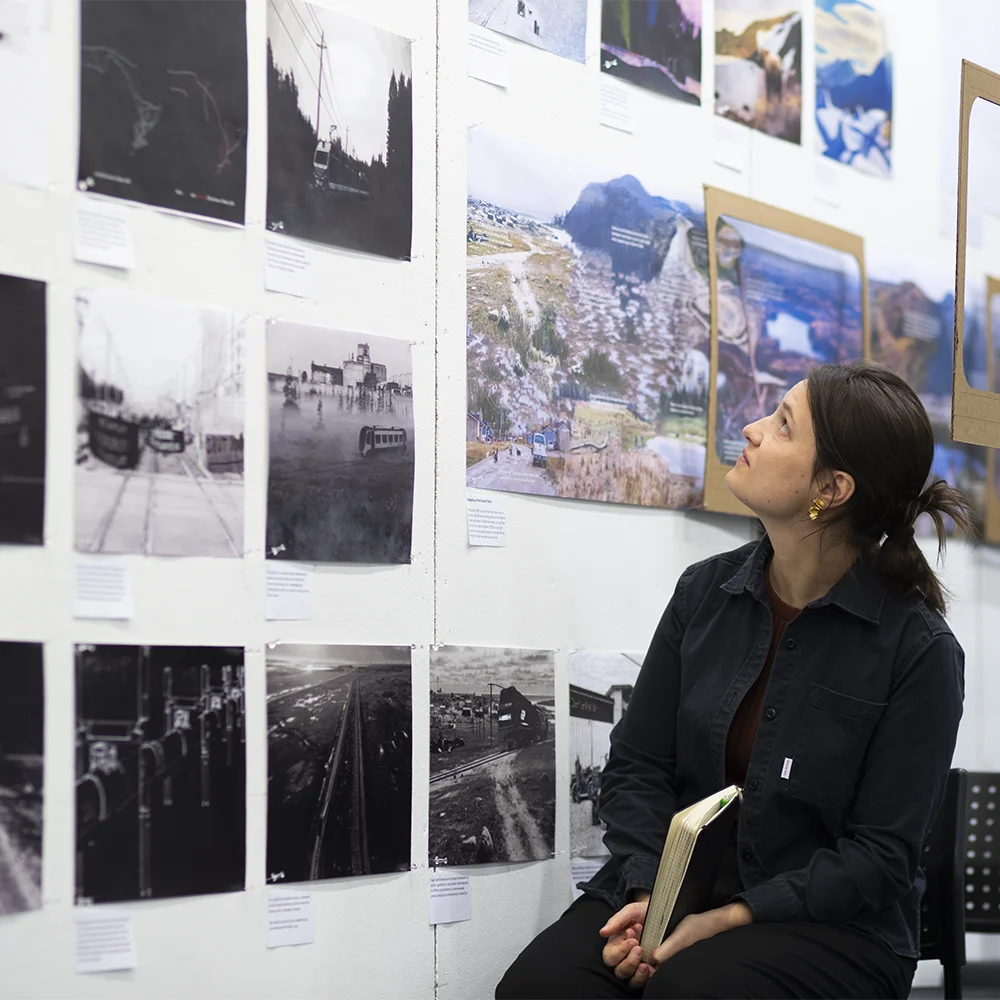
Studios will hold their final reviews at the Tyler School of Art and Architecture on Monday, April 27, Tuesday, April 28, and Wednesday, April 29.
Undergraduate reviews will be held from 1-6 p.m.

LARC 1144 instructed by Nathan Heavers and Pierie Korostoff
Location: Tyler Atrium Gallery 15
This studio explores the language, principles, design elements and processes of landscapes at the human scale. Students draw and document spatial experiences to gain an understanding of scale, proportion, texture, contrast, unity, hierarchy, mystery, coherence, variety, structure and function in landscapes.

LARC 2144 instructed by Billy Fleming
Location: Tyler Atrium Gallery 12
The future of life on this planet depends on our ability to design and manage a rapid transition to carbon-free energy sources by the middle of the 21st century. For spatial practitioners to find a role in the buildout of this future, we will need to develop new ways of breaking with the status quo of commercial practice. In this studio, we will do so by working directly with the carbon and energy systems of Philadelphia, with a particular focus on the neighborhoods and sites most impacted by their costs and burdens.

ARCH 3232 instructed by Ulysses S. Vance and Allen Pierce
Location: ARCH 104
Together, the two words suggest how this studio asks students to design multiple construction methodologies and to resolve their joints. Masonry + framing systems, structure + cladding, new + existing, and more. Together, the instructors refer to both a bus station and a welcome center as “places of assembly” for various modes of transportation converging on 30th Street Station.

ARCH 4332 Capstone Studio instructed by Andrew Wit
Location: Stella Elkins Tyler Gallery
This studio focuses on the design of an urban kindergarten, examining its program, the uniquely designed spaces that comprise the whole, and its relationships to humans, non-humans, and the environment. The project also considers the kindergarten’s engagement with future technologies and its surrounding urban context. Through this project, the goal is not to reproduce known typologies, but to explore the potential of what spaces, buildings, and environments might become. What is the purpose of learning environments in the twenty-second century? Will they remain isolated buildings, or evolve into integral components of social and ecological systems?

ARCH 4332 Capstone Studio instructed by Chris McAdams, AIA
Location: ARCH 103
This studio examines the multifaceted relationships between urban cemeteries—often overlooked, underutilized open spaces—and the evolving cultural attitudes toward their use. Students will be tasked with developing design strategies that accommodate a diverse range of users—including those experiencing profound grief, individuals seeking connection to the past, and casual visitors wanting respite in an urban oasis. This studio pushes the boundaries of architectural representation through animated storytelling. Students will master storyboarding, experiment with lighting and materiality, and develop their own unique architectural expression—all culminating in the production of a captivating short film that brings new architectural visions to life.

ARCH 4332 Capstone Studio instructed by Pablo Meninato, PhD
Location: Stella Elkins Tyler Gallery
The studio focuses on a section of the North Broad Street corridor, extending from the Vine Street Expressway to Indiana Avenue. This area, which includes Temple University’s main campus, faces significant structural challenges, including high unemployment rates, limited access to social services, persistent violence, homelessness, and numerous underutilized or vacant lots. At the same time, it is characterized by strong community networks, cultural resources, and a robust public transportation system connecting to Center City.

FM 4099 instructed by Alana F. Dunoff, FMP, IFMA Fellow
Location: ARCH 304
The FM Capstone Class is designed as an immersive, hands-on experience, guiding students through the practical application of facility management concepts in real-world scenarios. Students are grouped into consulting teams, each partnered with an actual client organization. Throughout the semester, teams tackle a series of academic problems using authentic client data, resources, and challenges, mirroring the dynamic environment that facility managers face in large, complex organizations.

ARCH 3060/ARCH 9480 instructed by Justin Bernard
Location: Architecture 2nd Floor Hallway
This course explores two primary projects. The first, A Place to Sit, asks students to conceptualize, design, and prototype a unique seating object using a single sheet of plywood — no fasteners, no adhesives, relying entirely on digital joinery to give the prototype its structure. Material constraint operates as a design opportunity, scoping both the ambition and the logistics of each project. The second project invites students to informally collaborate on a room-scale installation within an 11' x 11' x 11' volume. Each designer contributed at least one object — furniture or object-like in nature — prototyped using two or more materials, again without traditional fasteners or adhesives, and designed to coexist within a shared space and collective vision.
Graduate reviews will be held from 1-6 p.m.

ARCH 5232 instructed by Sonja Bijelic, RA
Location: Arch 104
The Media Center & Art Studios is a center for artists working across multiple media to interact and engage with one another while simultaneously energizing the surrounding neighborhood and the city. The Center consists of two distinct building components:
The site is located in Philadelphia along the Avenue of the Arts—a city-designated cultural district—at 615–29 South Broad Street, at the corner of South Broad Street and Bainbridge Street.

ARCH 8012 instructed by Clifton Fordham
Location: Arch 104
Structures have a finite lifespan unless there is a commitment to renew them. Buildings constructed in the postwar era are at risk of demolition due to deterioration and the fact that the programs that they were constructed for have evolved. This semester we will tackle the challenge of refreshing the facades of two structures, one which can be defined as profane and the other as sacred. In both cases, the facades of the buildings are troubled both aesthetically and functionally (including low thermal performance). Students in this studio will methodically develop new futures for these buildings utilizing a breath of patterns and textures (depth) through iterative development across different media.

ARCH 8012 instructed by Jeff Richards
Location: Tyler Atrium Gallery 15
In the summer of 2026, the Ambler Design/Build Institute will adaptively redevelop the former Johannes Kepler observatory at Temple's Ambler campus. In partnership with Circular Philadelphia "a non-profit organization that promotes the transition from a linear (take-make-dispose) economy to a circular economy in the greater Philadelphia region," Tyler Architecture students will explore concepts of circularity to design and build a new life for this long abandoned scientific asset.

ARCH 8013 instructed by Mauricio Bertet
Location: Stella Elkins Tyler Gallery
This comprehensive studio aims to explore and develop how adaptive reuse architectural strategies can revitalize an outdated but relevant building through its renovation and reprogramming to meet contemporary needs. The Continental building, located in the SW corner of Market and 4th streets in Philadelphia, PA, was designed by the architecture office of Burton W Berger and Salvatore Caltabiano and completed in 1970. The most notable architectural feature of this office building is likely its precast concrete façades, articulated through repeated splayed window elements, and clearly referencing other modernist architectures from the same time period.

ARCH 8013 instructed by Robert Shuman Jr., AIA LEED AP
Location: Stella Elkins Tyler Gallery
The semester studio project is a new community center for the North Central Philadelphia neighborhood just across Diamond St from Temple’s Main Campus. The site address is1301 Diamond Street, the south end of the block located on the northwest corner of 13th & Diamond, bounded on the west by the 2100 block of the former Park Ave (vacated by the City) and on the north by Susquehanna Avenue. The asphalt paved site is currently being used as a parade/drill ground, parking, and recreation area for the Philadelphia Military Academy, a charter high school that is occupying the former James Elverson Jr. Public School.
Architecture Thesis and Landscape Architecture Capstone Presentations will be held from 12:30-6:30 p.m. in ARCH 103 and ARCH 104.
Capstone Restoration and Design Project, LARC 9995, is the final course in the Master of Landscape Architecture (MLArch) degree program, which possesses a concentration in ecological restoration. Students complete an independent project on a site of at least five acres in size that is physically accessible and may include shareholder engagement and input.
Preceding this course, students complete research design methods, landscape restoration management and monitoring, and seminar courses that inform or are directly applicable to their projects. Refereed literature and case studies contribute to the creation of a thesis statement that is tested through site design with a goal of advancing landscape architecture, and possibly, ecological restoration. Students perform a site inventory and analysis prior to the creation of comprehensive and enlarged site designs. While unconventional means of representation are welcome and encouraged to communicate design proposals and support theses, students should also present forms commonly employed in landscape architectural practice, such as illustrative and construction plan drawings.

MarshLab Philadelphia
Advisors: Laurin Aman, Billy Fleming, Margaret Gallagher, Mark Gallagher, Nate Heavers
Emerging urban wetlands in Philadelphia can act as catalysts for fundamentally changing how people live in the city when they are developed as wetland “learning settlements,” wherein residents collectively meet core needs for food, medicine, shelter, craft, and community through direct relationships with the wetland landscape, rather than through wage labor and consumer markets.

Lowlines
Advisors: Billy Fleming, Margaret Gallagher, Mark Gallagher, Nate Heavers
The transformation of defunct urban infrastructure like the Conrail corridor of northeast Philadelphia can re-connect the urban fabrics that it was designed to divide and exclude.

Tidal commons: Designing for people and the river along the tidal Schuylkill River Trail
Advisors: Billy Fleming, Margaret Gallagher, Mark Gallagher, Nate Heavers
Through the design of living shorelines and constructed wetlands structured around freshwater mussel habitat, Tidal Commons demonstrates how the Schuylkill River Trail can function as regenerative infrastructure that supports aquatic ecosystems, deepens community connection, and strengthens resilience to climate change.

The Wingohocking Mosaic
Advisors: Billy Fleming, Margaret Gallagher, Mark Gallagher, Nate Heavers
Thesis: By restoring buried streams through multi-scale, community-driven interventions, urban neighborhoods can create social and ecological infrastructure that builds resilience to flooding and draws on water's capacity to connect people to each other and to their watersheds.

Cultivating community: A neighborhood approach to urban agriculture in Philadelphia
Advisors: Billy Fleming, Margaret Gallagher, Mark Gallagher, Nate Heavers
Building the capacity of existing community gardens and neighborhood residents can create a more connected and regenerative landscape of urban agriculture that continues its legacy as a practice of self-determination, community-building, and cultural expression.
Self-directed architectural design thesis that follows the research and design inquiries conducted in the fall semester.
The course requires that students demonstrate the ability to undertake design research, develop a design program, conduct analytical and speculative design investigations, and utilize advanced visualization techniques in the representation of their work. It culminates in a formal juried presentation and a textual document of a publishable standard of a graduate level design thesis.

Community as Our Living Room: Reimagining the Size of a Home to Bridge the Gap Between Public and Private
Advisor: Pablo Meninato
The American housing market has not only transformed in cost and scale but has also reshaped how we live together. As homes have grown larger with smaller household sizes, architecture has increasingly favored private comfort over collective experience.

Tech Tower: Re-framing Skyscraper Design, Construction, and Industrial Workflows
Advisor: Andrew Wit
This thesis investigates whether advanced design and construction technologies, specifically digital workflows, prefabrication, and robotic assembly (both off- and on-site), can improve the economic feasibility of high-rise development in Tier-2 real estate markets.

Louder Than Bombs: Uncovering the Voice of Architecture in Post-War Intervention
Advisor: Sonja Bijelic
The tragic toll of war extends far beyond human lives, leaving a devastating scar on the built environment. In the wake of conflict, cities stand as silent witnesses, their shattered buildings a testament to the violence they endured.