
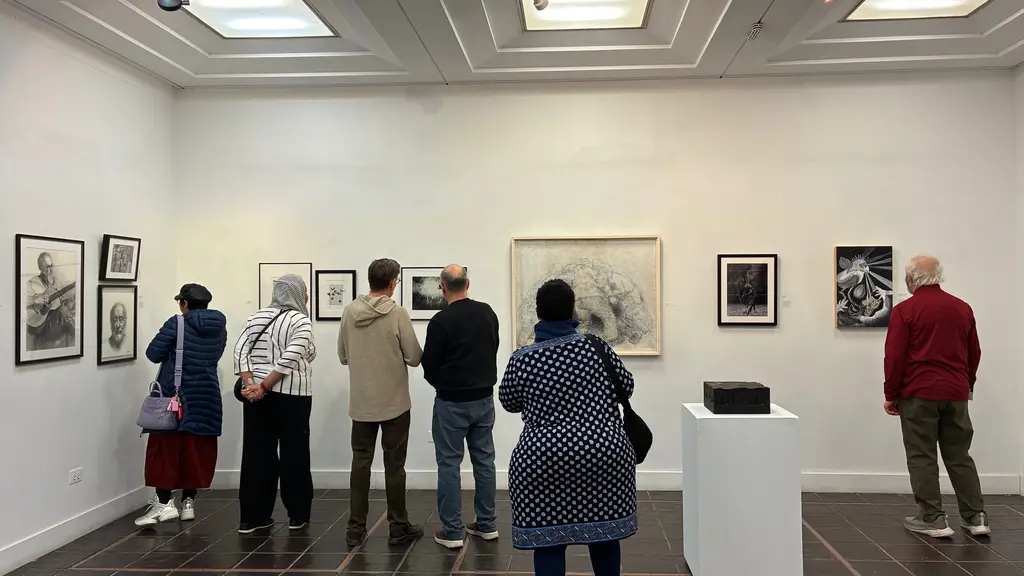
Gallery vistors browse artwork during the 2026 Annual Juried Show: Black & White at Abington Art Center. Photo provided by Abington Art Center.
Each year, Abington Art Center, located in Jenkintown, PA, hosts its juried exhibition bringing together artists from around the state to express themselves in new and interesting ways.
This year’s exhibition, Black & White, explores the striking visual contrast created through an achromatic theme while also, unexpectedly, bringing together the creative perspectives of two Owls from opposite ends of the generational spectrum—Gen Z and the Silent Generation. The featured artists are Ethan Flood, an undergraduate painting major, and celebrated painter, sculptor, and ceramist John Costanza (BFA ’49).
When asked about Tyler, Flood and Costanza both expressed a similar sentiment—appreciation for how the university allowed them to fully explore their artistic potential.
“I wanted to be in a larger art environment. I was living in Richmond, which is an interesting city, but it just wasn't as exciting as Philadelphia,” Flood said about transferring to Tyler from Virginia Commonwealth University. “I've really enjoyed my time here so far. I can explore Philly a lot, which is something that I really love to do, even though I grew up 25 minutes outside of the city.”
Drawing on both personal and cultural influences, Flood’s art explores memory, being, and perspective. His piece Garage, featured in the Abington Art Center’s showcase, explores themes of urban isolation.

Garage, 2024, charcoal on paper, 24” x 36”. Photo provided by the artist.
“At the time, I was looking at a lot of Edward Hopper’s work,” Flood said. “This was when I was in Richmond, you can sort of see some buildings in the distance, but I'm the only figure in this piece.”
Flood’s more recent work is documentarian in style, incorporating polaroid-inspired portraits drawn from his experience as a Boy Scout at the organization now known as Scouting America.
“I’m an Eagle Scout, so it's a big part of my childhood,” he said. “I think the way the organization has changed is really interesting, and it also gives me a chance to reflect on my experiences.”
In addition to giving him the space to explore these concepts, Flood credits Tyler for connecting him to peers that help inspire and motivate him.
“Being part of the Painter’s Guild helped establish a sense of community, and it’s nice to get advice on my work once a week,” he said. “Going to show openings and galleries and things has also been exciting. I think you can really connect with the faculty and get to know your peers here.”

Ethan Flood standing in front of Garage. Photo provided by the artist.
In the late 1940s, when John Costanza was an undergraduate student, Tyler looked totally different. Known at that time as the Tyler School of Fine Arts, the school operated out of a Georgian mansion in Elkins Park, Pennsylvania—an estate that had been gifted by artist Stella Elkins Tyler in 1935 with the intention that her mentor, Boris Blai, would use it to create a learning environment for the arts.
“The Tyler estate was in an old mansion. I remember there was a café called Kretchma, which was Russian for ‘café.’ The president at the time, Boris Blai, was Russian," he said, recollecting. “It was cozy, and there was a very relaxed sentiment on campus. Most of my professors were from New York, and they were very encouraging. They helped me lean into discovery."
Costanza credits the start of his career with mentorship—and an unexpected invitation by American landscape artist, Edward Glannon. At the time, Costanza was 12 years old and attended the Gramercy Boys Club in Manhattan.
"My mentor motioned me into his open art classroom,” he said. “He told me, ‘Paint your surroundings’. That advice became the foundation of my career.”
In 1943, Costanza graduated from the High School of Art, which at the time was called the High School of Industrial Arts. He was drafted and joined the Navy shortly after, serving as a radio operator throughout World War II. But his dream to become an artist never left.
“I had made up my mind a long time ago that I would be a message painter,” he said. “I wanted to make the world a better place through art."
After returning from deployment, Costanza applied to Tyler by employing advice from the same mentor that nurtured his interest in the arts.
“He told me to go to Tyler because it was the best in the country,” he said.
After graduating from Tyler, earning a BFA in ceramics, Costanza began working as a professor at Moore College of Art and eventually served as the chairman of their Ceramics Department.
Costanza has explored a wide range of mediums throughout his artistic career but always maintained a singular focus on creating work that connects people. His work has been displayed at the Philadelphia Museum of Art, Everson Museum of Art, and the Smithsonian, with pieces in permanent collections at Temple University, the University of Delaware, and more.

craps, 2022, Acrylic and conte. Photo provided by the artist.
“Being a message painter is about sharing a positive perspective with others through art,” he said. “I am primarily a painter now, and my work is somewhat autobiographical.”
His painting, craps, was selected to be included in the Abington Art Center’s juried exhibition. It features a group of people playing a game of dice and is plucked right from a childhood memory.
“I was a child in Manhattan on the East Side and I saw men on the corner playing dice,” Costanza said. “I remember that moment vividly and one day the idea came into my head to make a painting of it!”
His advice for current Tyler students—keep doing what you love.

Ethan Flood and John Costanza's work on display at the Abington Art Center. Photo provided by Abington Art Center.
"If you like what you do and you keep doing it, you will succeed. Just keep doing it,” he said. “Keep showing up."
Ethan Flood and John Costanza’s work will be on display at the Abington Art Center until April 13. Learn more about the showcase here.