
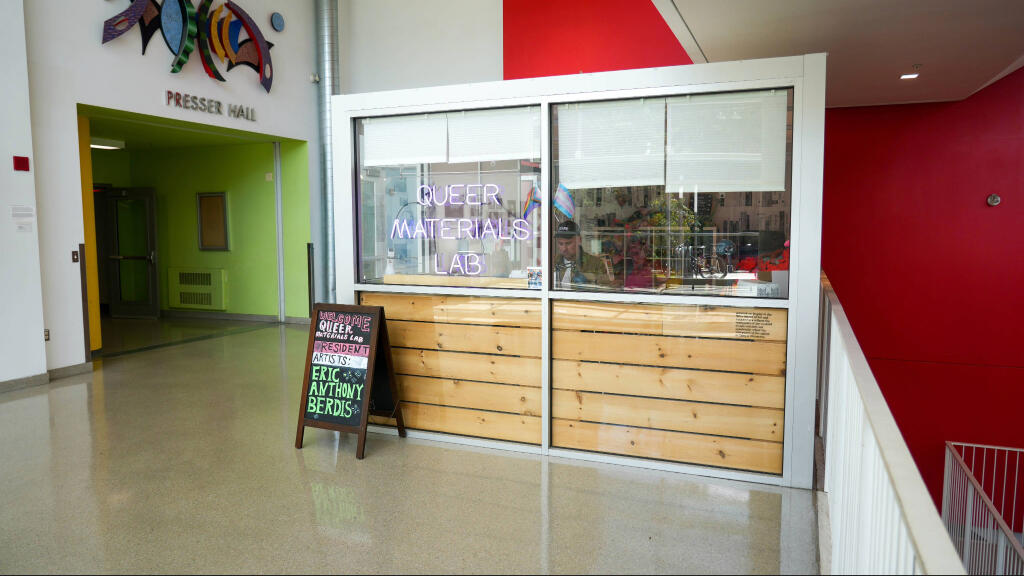
Pictured above: The Queer Materials Lab, located in the Tyler atrium. Photo by Amara Johnson.
"The thing about the Queer Materials Lab is the beauty of making what you want. There’s no one concrete formula,” said Eric Anthony Berdis, the 2026 Queer Materials Lab Artist in Residence. “The lab invites scholars—not just fiber artists. It also thinks with painters, printmakers, writers, musicians and performance artists who maybe don’t identify as ‘queer’ but are thinking or want to think queerly about their work. I think that’s really unique.”
Located in the Tyler atrium, the Queer Materials Lab functions as an extension of Tyler School of Art and Architecture’s Fibers and Materials Studies program by offering opportunities for critical material research and experimentation.
Since 2018, the lab has brought artists from all walks of life together through artist residencies, short-term research projects and specialized events. Its four walls contain a cache of work from prior residents creating a lineage of fibers experimentation that continues to this day. Feather Chiaverini, the lead host of the Queer Materials Lab and adjunct faculty in the Fibers and Material Studies program, estimates that 24 artists have contributed to the project since its inception.
“Every semester, I get to show artists new fiber techniques, plan and scheme new projects, learn new things myself and giggle so much. I love the Queer Materials Lab,” they said. “My job has consisted of helping organize an art sculpture weightlifting event with artist in residence KT Abadir-Mullally, or one semester Marcellus Armstrong welcomed us every morning with a DJ set in the Tyler lobby. I feel very lucky that I get to work with so many fun and exciting artists!”
As this year’s Artist in Residence, Berdis brings extensive experience as an artist, educator and scholar while also incorporating community-focused art practices from having worked as an organizer for arts associations, libraries and shared creative spaces.
These skills give Berdis a unique perspective on how material arts weave communities, histories and modes of expression together to create new opportunities. Berdis often refers to this process as "DIY Collectivity," a way of thinking informed by Indigenous scholar Robin Wall Kimmerer, whose work Berdis encountered under the mentorship of Renee Jackson, associate professor and chair of art education at Tyler.
“This form of knowledge, weaving and braiding together, brings community, ancestral and academic knowledge together,” he said. “Philly has a wealth of artist-run art spaces and a community of people coming together to make amazing things happen.”
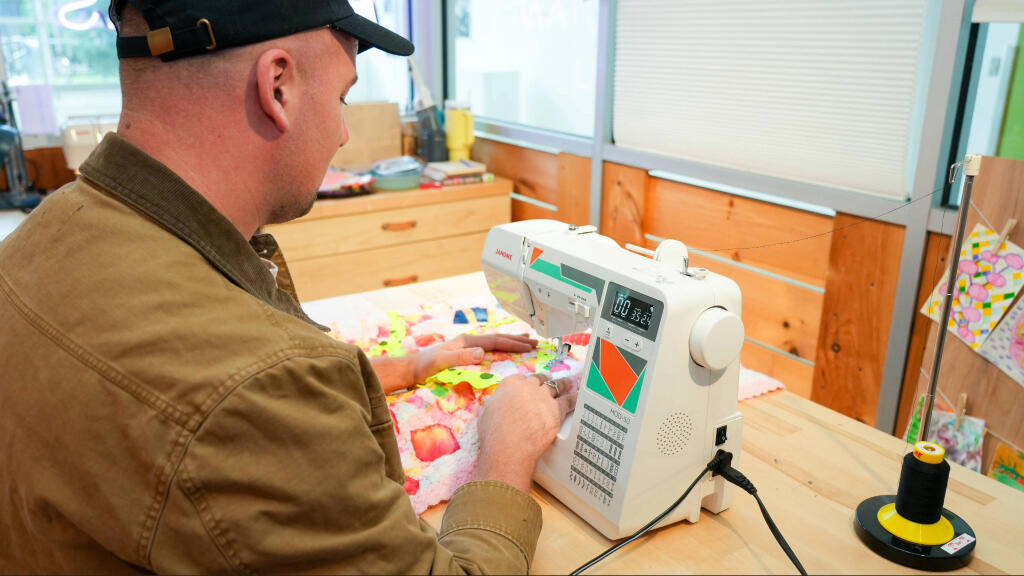
Pictured above: Eric Anthony Berdis working diligently in the Queer Materials Lab studio. Photo by Amara Johnson.
Berdis’ interdisciplinary expertise was refined as an undergrad when they decided to take a class in fibers and textiles. This class would be the beginning of his intersecting art education with material studies.
“[The class] opened a world of material for me within fiber practices, like quilting, sewing and embellishment," they said. "It opened an investigation of social and political commentary on the world through materials and invited me to think deeper about their histories. Ultimately, it led me to pursue a master's in textiles, fiber and craft material studies.”
And, while Berdis considers himself an educator at heart, the insights from their materials studies practice continue to act as a creative undercurrent to their work.
“I was always still a teacher. Like so many artists, I had my studio at night and my classroom during the day,” they said. “Those things have always been in rhythm or in tension together—fueling each other in a lot of ways.”
During their residency, Berdis has been exploring “sampling,” or the process of testing a small selection of materials prior to developing a larger work, as its own form of creation. In this regard, the projects and research left by former Queer Materials Lab residents have proved to be supportive guides.
“I'm calling them ‘unknown teachers’ because I haven't found out all their names yet, but learning from their discoveries in the archive has been quite enjoyable,” Berdis said. “Right now, I’m tinkering and working on small things. In Fibers, there’s a lot of value in the sampling process. I’m thinking queerly about that—about how samples can often become a point of departure. I’m really interested in the act of ‘returning’ and how that revisiting can inform new things.”
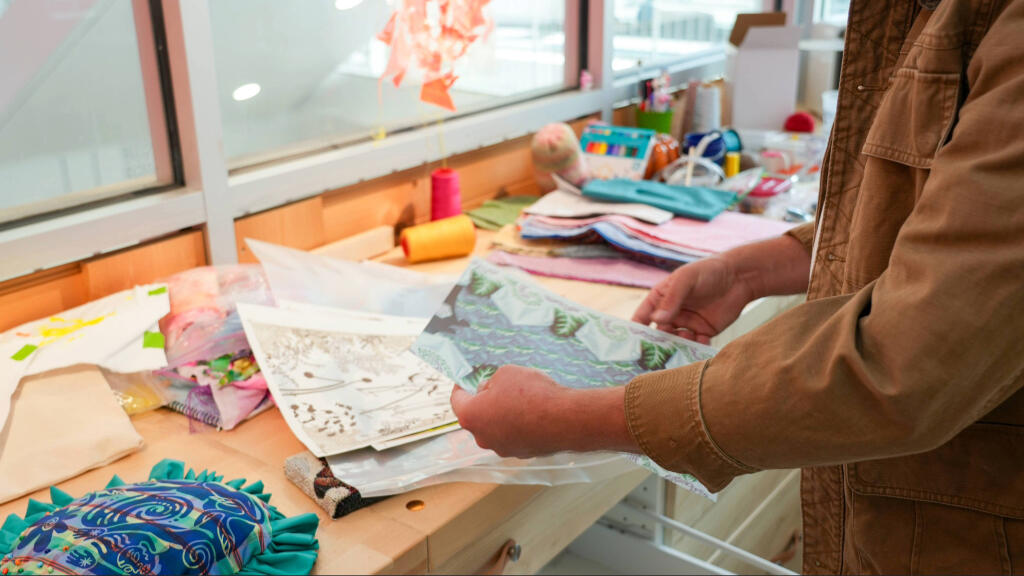
Pictured above: Eric Anthony Berdis looks through works and fabric samples from previous Queer Materials Lab residents. Photo by Amara Johnson.
To current students and the larger Tyler community, Berdis encourages visits to the Queer Materials Lab, Fibers & Materials Department and the Art Education program and sees them as opportunities for discovery and inspiration.
“When the door is open, feel free to come in and say ‘Hi’! Fibers is on the second floor, and Art Ed’s in the basement. Wander there, make a friend,” Berdis said. “The Tyler building is so exciting, and there’s something amazing happening in all of the studios."
Throughout their residency, Berdis will host a series of events that bring together art education, material studies and community connection. The first event in this series will be a Surrealist “exquisite corpse” style marble run, which will take place on Wednesday, October 7.
To learn more about Fibers & Material Studies and the Queer Materials Lab, visit this page.